What is an in-home or house-call pediatric provider?
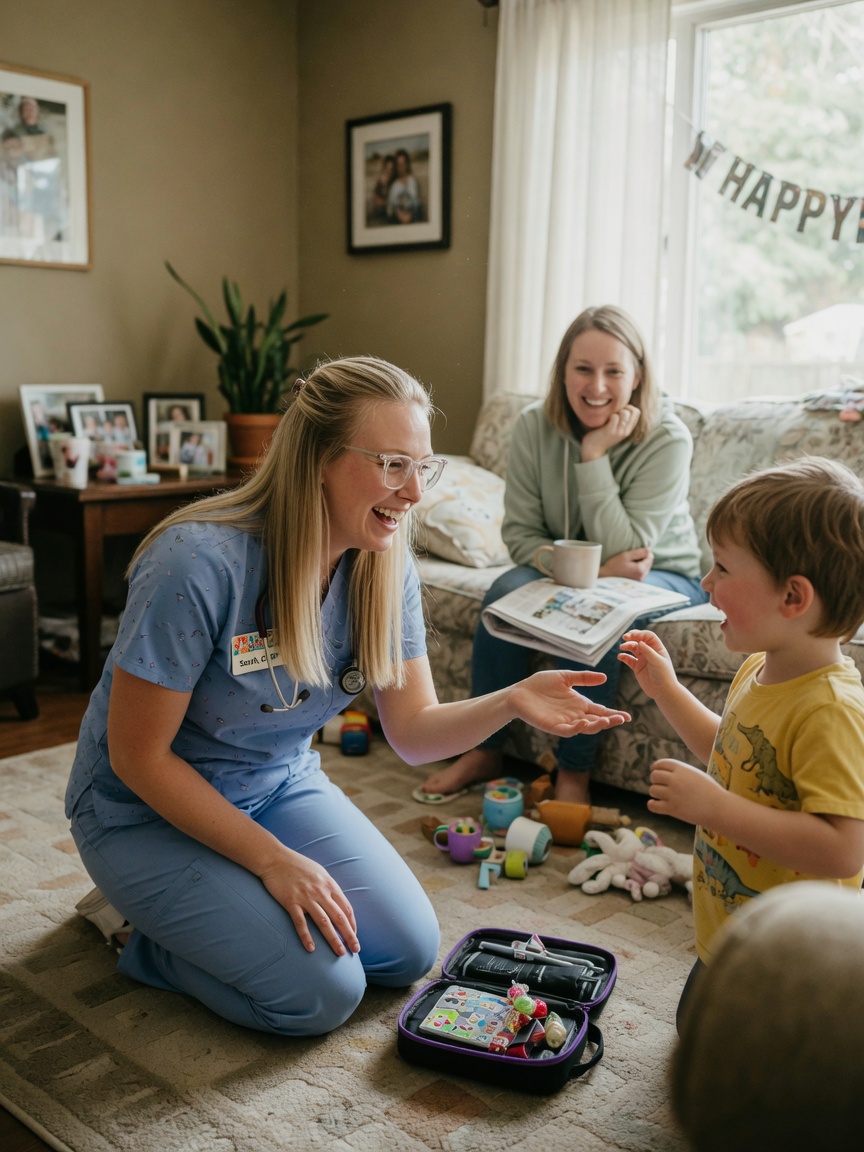
A house-call pediatric provider brings the visit to you. Your child is seen in their own living room or bedroom — the place they're most comfortable — rather than in an exam room across town.
You'll see a few different words for this, and they overlap:
- In-home / house-call / at-home / mobile pediatric care all describe the same idea: the provider travels to the family instead of the family traveling to a clinic.
- Concierge usually just means a more personal, come-to-you, directly-reachable style of care.
- Direct primary care (DPC) is the membership structure underneath it — a flat monthly membership fee instead of billing insurance per visit.
At Thriving Olive, those pieces come together: it's a direct primary care membership, and the care is delivered to you at home and by video. We're not the $10,000-a-year concierge-medicine stereotype — just a small membership practice built around seeing your child where they're comfortable and being easy to reach. Here's more on why families choose pediatric direct primary care.
If you want a step-by-step look at a single visit — what the provider brings, how long it takes, what actually happens in the room — we wrote that up separately: what happens during an in-home pediatric visit. This page is about the bigger picture: what in-home care is as an ongoing option for your family.
Who is in-home pediatric care especially helpful for?
It helps almost any family, but a few situations make the difference really obvious. These are the Jacksonville families we hear from most:
- Two working parents with no time to burn in a waiting room. When neither of you has PTO to spend sitting in a lobby, "the provider comes to us" changes the whole day. ("My child just spiked a fever and I'm not sure what to do — I can just call Lori.")
- Newborns and homes with several young kids. Loading a newborn plus two toddlers into a car for one sick visit is its own event. Staying home is simpler, and it means fewer trips in and out with little ones.
- An anxious or sensory-sensitive child. For a child who melts down in unfamiliar medical settings, being seen at home — on the couch, with their own things around them, in a place they already know — is often a calmer experience for everyone. In our experience, familiar surroundings and comfort objects help a lot of kids settle during a visit.
- A sick child you don't want to expose to a crowded waiting room. If your child is already run down, a lobby full of other coughing kids is the last place you want them. And it works the other way too — your contagious child isn't sitting next to someone else's newborn.
The common thread is simple: less hauling, less waiting, and the same person each time.
What's handled at home, and what gets referred out?
A lot of everyday pediatric care travels well to the living room. At Thriving Olive, in-home and virtual visits commonly cover things like sick visits, many minor injuries, routine well checks and sports physicals, and follow-ups — you can see the full list on our Services page.
Two things worth knowing are available as add-on services, not standard with every visit: when it's appropriate, in-home lab draws and minor wound repair can often be handled at home. Whether either one makes sense in a given situation is always your provider's call at the time. We'll tell you up front when something is an add-on.
And we're honest about the limits. Some things genuinely belong somewhere with more equipment — imaging like X-rays or ultrasound, certain lab work, anything needing a specialist, or a true emergency. When that's the case, your provider helps coordinate where to go and what to expect, rather than leaving you to sort it out alone.
If a referred-out service does come with a cost — imaging or outside labs, for example — there are often self-pay or cash-pricing options to look into, and some families carry a catastrophic or high-deductible health plan as a safety net for the bigger, less-common things. We'll talk through the practical options with you — the goal is no surprises.
This page is general information, not medical advice for your specific child. What's right in any individual situation is a conversation to have with your child's provider.
The part parents tell us matters most: continuity
Here's the difference that tends to matter most over time. In a busy, insurance-based practice, you may see whoever's available that day, and consistently getting your follow-up with the same provider can be harder to count on.
With an ongoing membership, it's the same provider every time. So when the question is "is this rash getting better or worse?", you're not starting over with a stranger. ("My child developed a rash — I can call Lori, and she's there to help.") That direct access and that continuity are the whole point, and they can be harder to come by in a high-volume practice.
Lori Olivarez, APRN, is a pediatric nurse practitioner with more than 20 years caring for kids, including about six years in the pediatric emergency room at Wolfson Children's Hospital. That background is part of why the "should we worry about this or watch it?" conversation can happen calmly, with someone who knows your child.
How does the service area work in Jacksonville?
Thriving Olive is a service-area practice, not a walk-in clinic — care comes to you across select areas of greater metropolitan Jacksonville, with virtual visits filling in the gaps.
Not sure whether your home is in the service area? That's an easy thing to check on a quick call before you commit to anything.
How "concierge," "DPC," and "house call" fit together
It's easy to get tangled in the vocabulary, so here's the plain version:
- Direct primary care (DPC) = the payment model. A flat monthly membership fee covers your child's care, instead of billing insurance visit by visit. Curious whether it pencils out for your family?
- Concierge / house-call = the style of delivery — personal, directly reachable, and coming to your home.
- Telehealth / virtual care = the companion to in-home visits for the quick questions and check-ins where you don't need someone at the door — one of the services included in membership.
Put together, it's one relationship: a membership, a provider who comes to you, and a way to reach that provider in between.
Frequently asked questions
Is a house-call pediatric provider the same as urgent care?
Do you only come to my home, or can we also do video visits?
What if my child needs something that can't be done at home?
Is this instead of insurance?
How much does it cost?
What about weekends or after-hours — what if it's serious?
How do we get started?
Start with a free meet-and-greet
The easiest first step is a quick, free meet-and-greet — by video so we can see each other, or a phone call if you'd rather stay off camera. Meet Lori, ask whatever's on your mind, and find out whether in-home membership care fits your family.