What an in-home pediatric visit actually is
An in-home visit is exactly what it sounds like: your child is seen at home rather than in a clinic. The medical care is the same kind of care you'd expect at a well or sick visit — a history, a hands-on exam, and a plan — just delivered where your child already feels comfortable.
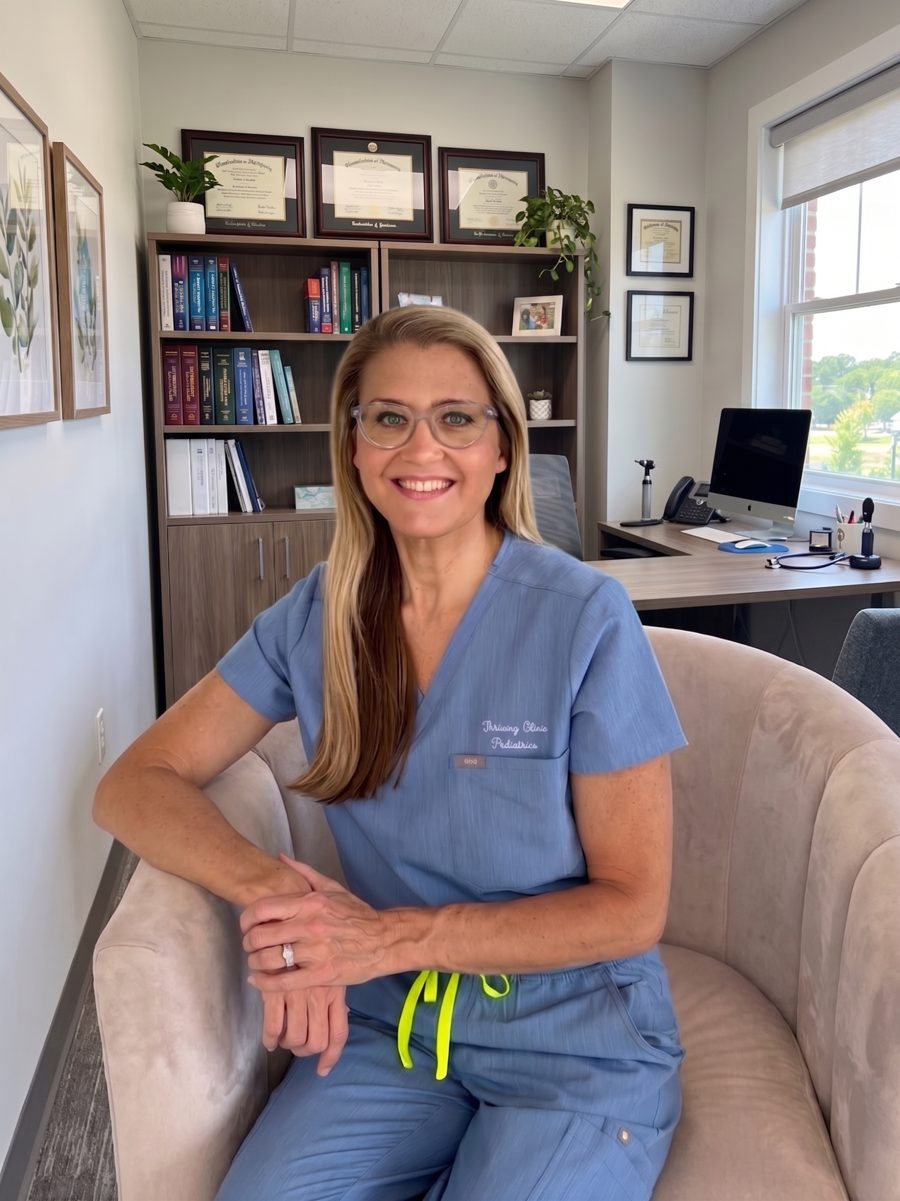
At Thriving Olive, your provider is Lori Olivarez, APRN, a pediatric nurse practitioner with more than 20 years in pediatrics, including 6 years in the pediatric ER at Wolfson Children's. She brings the medical equipment needed for the visit to your home.
Because Thriving Olive runs on a Direct Primary Care (DPC) membership — a flat membership fee, cash-pay, not billed through insurance — visits aren't rushed to fit an insurance schedule. There's time to ask the questions you actually came with.
Step by step: how an in-home visit works
1. You reach out — often for same- or next-day care
When your child is sick or something's worrying you, you message or call directly. For members, sick visits are typically available the same or next day. You're talking to your provider's practice, not a phone tree.
2. The provider comes to you
Instead of loading a feverish toddler into a car seat and sitting in a waiting room, you stay home. Lori arrives with the equipment needed to examine your child and work through your concerns.
3. The unhurried visit at home
This is the part parents tend to be surprised by. There's time. Your provider examines your child, listens to the full story, and explains what she's seeing in plain language. Kids are often calmer on their own couch, which can make the exam easier — especially for little ones who associate clinics with shots. Unfamiliar medical settings are a well-recognized source of anxiety for children, so being seen somewhere familiar can simply feel less stressful for many kids.
If testing would help, some in-home lab tests are available at an additional cost — for example, flu, RSV, strep, mono, glucose, and urinalysis. Rapid point-of-care tests like these are commonly used in outpatient pediatric care to help guide decisions during the visit. Minor wound repair — sutures, staples, or skin glue — can also be done at home at an additional cost when appropriate. Sutures, staples, and tissue adhesive ("skin glue") are all standard options for closing minor lacerations, with glue often well-suited to small, low-tension wounds in children. These add-on services are not included in the membership fee.
4. After the visit: messaging and follow-up
Care doesn't stop when the visit ends. Members can message their provider with follow-up questions — the "is this rash looking worse or better?" check-in that usually goes unanswered elsewhere. If your child needs a recheck, that's arranged directly.
What can be done at home — and what gets referred out
Being honest about the limits is part of good care. A lot can happen at home: exams, many common illness and injury visits, well checks, and the point-of-care tests and minor wound repairs noted above.
Some things genuinely belong elsewhere, and your provider coordinates those for you:
| Done at home | Referred out (coordinated for you) |
|---|---|
| Exams, sick visits, well visits | Imaging and X-rays (need facility-based equipment) |
| Select in-home lab tests (added cost) | Hospital and ER care |
| Minor wound repair (added cost) | Specialist care |
| Guidance and follow-up by message | Vaccines |
A note on vaccines: they are not given at the practice. Lori provides evidence-based guidance on immunizations — grounded in the American Academy of Pediatrics' recommended childhood and adolescent immunization schedule — and refers families to the health department or other options to receive them.
For imaging, hospital care, specialists, and the ER, insurance is used — and your provider helps coordinate the referral so you're not navigating it alone.
Who in-home pediatric care tends to be especially good for
Every family is different, but a few situations line up particularly well with care that comes to you:
- Newborns and their recovering parents, when leaving the house is genuinely hard.
- Families with multiple kids, where packing everyone up for one appointment is its own ordeal.
- Anxious kids, who often feel more at ease in a setting that doesn't feel clinical — unfamiliar medical environments are a recognized source of stress for children.
- Sick kids, who feel miserable and don't need a car ride and a waiting room full of other germs.
- Busy or working parents, for whom the time saved is the difference between care and "we'll wait and see."
How in-home care fits the membership
At Thriving Olive, in-home visits are part of the Direct Primary Care membership rather than a per-visit charge. Membership means your covered visits are included for a flat fee, there are no insurance claims or surprise bills for those visits, and there's no waiting room — the care comes to you or happens by telehealth.
Add-on services like in-home lab testing and minor wound repair carry an additional cost on top of membership, and anything referred out (imaging, specialists, the ER) runs through your insurance.
You can see the full list of in-home, sick, well, and virtual visits we offer, how the membership is structured on our memberships page, and read more about why families choose pediatric Direct Primary Care.
When you should still go to the ER or call 911
In-home care covers a great deal, but some situations need an emergency room or 911 right away — and knowing that in advance is part of caring for your child well.
Call 911 or go to the nearest ER right away for warning signs such as: trouble breathing (breathing fast, ribs or chest pulling in with each breath, or blue or gray lips, tongue, or face); a seizure; being unresponsive or so sleepy your child is hard to wake; a severe allergic reaction; a sudden purple or bruise-like rash; a stiff neck with sensitivity to light; persistent vomiting that keeps anything from staying down; a major injury (such as a bone that is visibly bent or protruding, or a suspected spinal injury); or any time your instinct says your child needs emergency help.
Fever in a very young baby is its own urgent situation: for an infant younger than 3 months with a rectal temperature of 100.4°F (38°C) or higher, contact your pediatric provider or seek care right away — any fever at this age needs prompt evaluation rather than a wait-and-see approach. (Because the response is the same every time, a rectal reading is the most reliable way to check an infant's temperature.)
When you're not sure, that's exactly the kind of question your provider is there for — reach out, and you'll get a real person who knows your child.
Frequently asked questions
Is an in-home visit as thorough as a clinic visit?
Does the provider bring equipment to my house?
Can my child get vaccines during an in-home visit?
Does insurance cover in-home visits?
What areas do you serve?
A warm next step
If in-home pediatric care sounds like it might fit your family, the easiest first step is a free intro call — no pressure, just a chance to ask your questions and see whether it's a good match.
This article is general health education, not medical advice for a specific child. Every medical claim has been reviewed for accuracy against authoritative pediatric sources (American Academy of Pediatrics / HealthyChildren.org, AAFP, and peer-reviewed literature). For guidance about your own child, reach out to your provider.